Akropolis: The High City That Outlived Every Empire That Held It
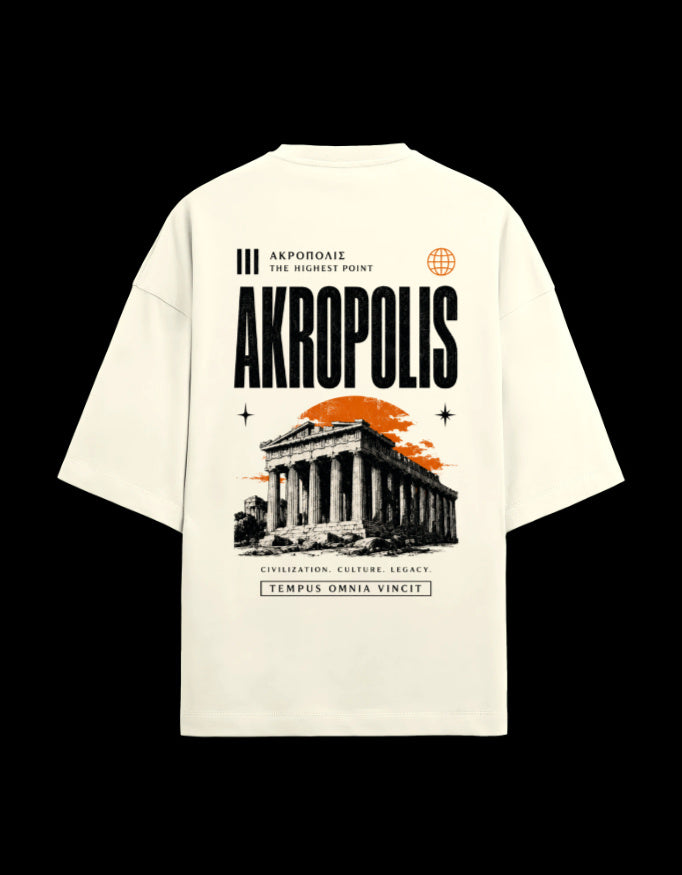
The word is a description, not a name
Akropolis (ἀκρόπολις) is a compound: akros, highest or topmost, and polis, city. A high city. It began as a common noun, not a title. Almost every Greek polis had one, a defensible outcrop holding the temples, the treasury and the last retreat. Corinth had Acrocorinth. Argos had the Larisa. Only later did it narrow, in ordinary use, to a single rock in Athens.
That rock is a limestone plateau rising some 150 metres above sea level, flat on top, sheer on three sides. Mycenaean builders walled it in the thirteenth century BC. The Persians burned everything standing on it in 480 BC. What we look at now was raised on the ash of that sack.
Fifteen years and one building
The Parthenon was built between 447 and 432 BC under the political direction of Pericles. Iktinos and Kallikrates were its architects; Phidias directed the sculpture and made the chryselephantine Athena inside it, gold and ivory over a wooden core, roughly eleven metres tall, lost long ago. The marble was quarried at Mount Pentelikon, some sixteen kilometres away.
The funding was contested at the time. Athens had moved the treasury of the Delian League from Delos to the Acropolis in 454 BC, and money collected from allies for defence against Persia paid for the work. Plutarch, writing some five centuries after the fact, records the accusation that the city was gilding itself like a vain woman with other people's money. He is a late source, but the charge is unlikely to be his invention.
The building's precision is not a romantic legend. The stylobate curves upward toward its centre, the columns lean slightly inward and swell at the middle, and the corner columns are thicker than the rest. Nineteenth-century surveyors measured them. They are deliberate: they are why the temple reads as perfectly straight.
Church, mosque, powder magazine, ruin
The Parthenon has spent far longer as a Christian church than as a temple of Athena. Converted around the sixth century AD, it became a Latin cathedral under Frankish rule after 1204, then a mosque following the Ottoman conquest of Athens in 1458. Through all of it the building worked: roofed, used, maintained, still largely intact in 1687.
On 26 September of that year a Venetian force under Francesco Morosini shelled the Ottoman garrison holding the rock. The Ottomans had stored gunpowder inside the Parthenon. A mortar round found it. The explosion tore out the roof, the interior chamber and much of the colonnade, and killed the people sheltering there. Morosini then broke the west pediment further trying to lift sculpture off it as a trophy. The ruin photographed by every visitor is 339 years old, not two and a half thousand.
Tempus omnia vincit
Tempus omnia vincit — time conquers all — is a proverb, not a line from any classical author. It echoes two that are real: Virgil's omnia vincit Amor and Ovid's tempus edax rerum, time the devourer of things. Neither poet wrote it in that form, and it is worth saying so.
It remains the right sentence for the rock. Athenian democracy, Rome, Byzantium, the Frankish dukes, the Ottoman empire, Morosini, Elgin, the occupation of 1941 — every regime that ever held the Acropolis is gone, and the high city is still there. Conservators work on it now, removing the rusting iron clamps an earlier restoration drove into the marble a century ago. Time takes everything. It has simply not finished.
The myth, printed heavy: Akropolis Oversized Tee.