Kallos: Why Greek Beauty Was a Measurement, Not a Compliment
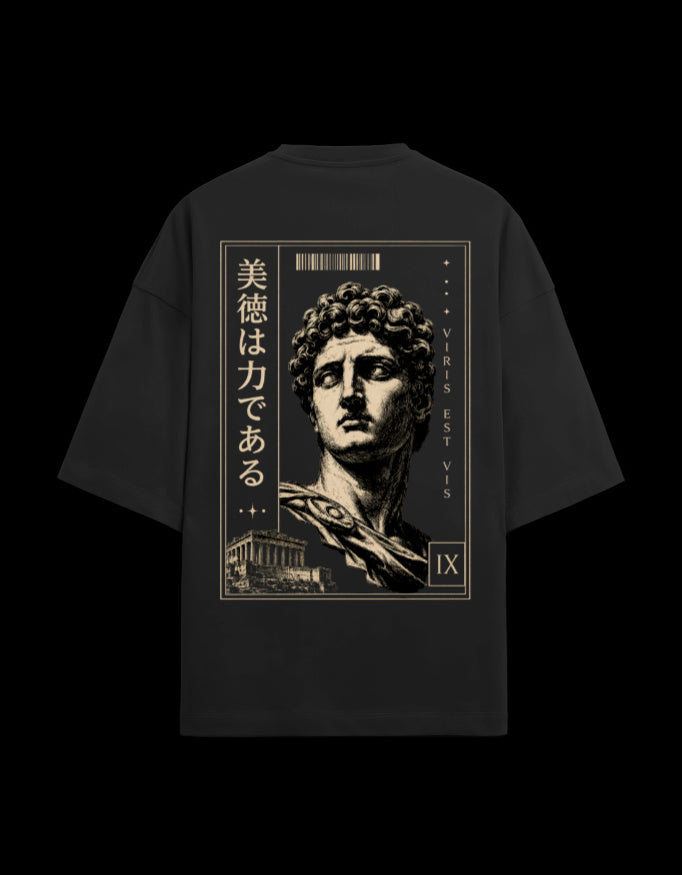
In Greek, kallos (κάλλος) is the noun for beauty. But the adjective standing behind it, kalos, does double duty: it means beautiful, and it means fine, noble, worth having. A ship can be kalos. So can a law, a death, a ratio. The language never quite separated how a thing looked from whether it was any good.
Beautiful and good were one word
The Athenian compound kalos kagathos — a contraction of kalos kai agathos, "beautiful and good" — was close to the highest thing you could say about a man. Xenophon reaches for it constantly in the Memorabilia and the Oeconomicus. Aristotle gives the abstract noun, kalokagathia, a chapter of its own at the end of the Eudemian Ethics. It was not a remark about a face. It described a man whose bearing, conduct and judgement held together. It also, in plain terms, described a class: the phrase carried the assumptions of the Athenian gentry as much as any moral test. Greek beauty was social before it was aesthetic.
Polykleitos tried to measure it
Around 440 BCE the Argive sculptor Polykleitos wrote a treatise called the Kanon and cast a bronze to demonstrate it — the statue generally identified with the Doryphoros, the Spear-Bearer, which now survives only in Roman marble copies. His principle was symmetria: not symmetry in our sense, but commensurability, each part standing in a fixed ratio to the next and to the whole. The physician Galen preserves the argument at second hand, running the chain through the body — finger to finger, fingers to the hand, hand to forearm, forearm to arm, and all of them to all. What the actual numbers were, nobody now knows; every reconstruction is a scholarly reading, and they disagree. The claim underneath them is not in doubt. Beauty was a relation, and relations can be got right or wrong.
Plato turned it into a staircase
In the Symposium, Socrates repeats what the priestess Diotima taught him. You begin by loving one beautiful body. You notice that the beauty is not the property of that body alone, and widen. Then the beauty of souls, which outlasts bodies; then of laws and institutions; then of knowledge; and at the top, the Beautiful itself — not beautiful in one respect and ugly in another, not beautiful to one man and not to the next, but simply and permanently so. Earlier in the same conversation, Diotima lets Socrates exchange the word "good" for "beautiful" mid-argument without his question changing at all. That substitution is the entire Greek position in one move.
Virtue is strength
The line printed on the back of this tee is Japanese: 美徳は力である — bitoku wa chikara de aru, "virtue is strength." The Japanese word for virtue, 美徳, pairs the character for beauty with the character for moral power. Two languages, a continent apart, refusing to keep beauty and worth in separate rooms.
Kallos was never decoration. It was the visible evidence that something had been made correctly: a body trained, a law argued, a proportion held. That is a harder standard than prettiness, and a more durable one. Printed heavyweight, 260 GSM cotton-poly terry, cut oversized.
The myth, printed heavy: Kallos Oversized Tee.